Rarely does a film exercise the public this much before it’s even been released, but Emerald Fennell’s “Wuthering Heights” – speech marks and all – has done it. This has been rumbling along for months actually, and certainly for longer than usual, even for most contentious film adaptations. Long before the trailer landed, it was all about who’s in the film. Fennell’s casting decisions – too old, too blonde, too pale – have been picked up on with what you could term accusatorial glee by people ready to get bent out of shape to prove their knowledge of the source text – knowledge which has turned out to be a bit piecemeal in places, if we’re being harsh. This continued; Catherine’s dresses were anachronistic; even the fabric was ‘wrong’; the accents were not up to scratch; finally, Fennell herself shouldn’t have bothered, being as she is too posh, and therefore somehow out of the running to direct a film where the spectre of class and wealth casts an undeniable shadow over the relationship between Catherine Earnshaw and Heathcliff… or, maybe that could work rather well? In some cases, hatred for the film feels more like personal hostility towards the director; perhaps consider what she could be doing with her unstinting privilege, and be grateful she’s making bold, original feature films instead.
Forget all of that. Or, rather, if you’re determined to be annoyed by “Wuthering Heights”, then fill your boots: there’s already a raft of affirmative reviews for that out there, many of which have had a blast evaluating a film against criteria it was never suggested it had. This fever dream version of the novel is visually stunning, captures elements of the book’s subliminal energy and passion that haven’t yet been brought to the screen, and though it plays fast and loose with key plot points, to this reviewer it feels affectionate and engaged, not cynical or jaded. If it’s all a bit much for you, then feel grateful that the novel’s worst excesses have been left on the page: tortured wildlife, hanged pets, imprisonment, domestic abuse, even unearthed corpses. Remember also that Wuthering Heights has been adapted for the screen many times, and not one has been a faithful retelling of Emily Brontë’s novel – a novel which, by the way, her sister Charlotte apologised for in her preface to the book, noting that it contained characters full of “perverted passion and passionate perversity”, which wouldn’t be a bad description of the 2026 film. In Emerald Fennell’s rendition, arguably her second take on the novel (oh come on: Saltburn essentially follows the same story arc), the second generation of Heathcliffs and Lintons never come into existence; the film sticks closely with the first-generation love story, not lingering on the legal apparatus later used by Heathcliff to disinherit those who wronged him, but staying very, very close to the mutual passion which made Brontë’s Heathcliff want to avenge himself in the first place. It’s a singular reading of the book, sure, but it’s valid, daring and gorgeous.
Starting with a public hanging which instantly conflates and foreshadows the film’s big, bold links between sex and death, we meet Cathy as a little girl. Her father, here a hybrid between the kindly, if odd Mr. Earnshaw who brings home a ‘Gipsy brat’ from a sojourn to the dock city of Liverpool and Cathy’s older brother Hindley (played with zeal by Martin Clunes) divides his time between getting grotesquely drunk and squandering all of his money on gambling, but finds a moment to bring home an abused and rootless little boy from the marketplace, christened Heathcliff by young Cathy. The child actors in this part of the film are fantastic. Owen Cooper, who plays Heathcliff, made a ferocious impact playing Jamie in the TV series Adolescence in 2025 and he’s great here, too, balancing the slow-burn of an ardent attachment to his foster sister with a masochistic, taciturn streak which turns readily into tangible cruelty in adulthood. Young Cathy (Charlotte Mellington) comes closest to capturing the ‘wild wicked slip’ epithet bestowed on her by Nelly Dean in the novel; it’s worth remembering that, landowners or not, the Earnshaws live on a working farm; there’s no long stays at school, no lessons in etiquette and no mother to keep her daughter in line. Little Cathy is a headstrong menace, even if her heart is (sometimes) in the right place. The Heights here is a like Fellini’s Satyricon (1969) come to the edge of the Yorkshire moors, by the way: the striking visuals of the house help to position the whole narrative somewhere on the fringes of reality and possibility, making the whole thing feel like a febrile hallucination. If you can get your head around that and accept it on its own terms, then you’ll likely enjoy the rest.
In adulthood, Cathy is at a loss what to do with herself: when she’s not dragging her skirts through pigs’ blood, she’s stuck in a childlike inertia, unmarried, without occupation and reduced to stamping her foot at her father’s ongoing excesses as the house threatens to disappear from under them via a slew of unpaid bills and debts. Her sexual feelings for Heathcliff, still on hold at this point, are quite suddenly lit by a touchpaper when she becomes innocently exposed to the fact that the servants are conducting assignations of their own in the darkest corners of the house; she sees this at the same time as Heathcliff does, but before anything happens, Cathy’s curiosity over the new, wealthy neighbours down at the stately Thrushcross Grange throw her into the path of the kindly Edgar Linton (Shazad Latif) and his ward – not his sister, in this film – Isabella (Alison Oliver). Catherine sprains her ankle trying to peer into this Secret Garden world and ends up staying for a period of time to recover. She returns to the Heights as a lady, or at least looking like one, and shortly afterwards – here compelled by the spectre of imminent poverty – she finds herself engaged to Mr. Linton. Heathcliff overhears her say that she has accepted Edgar, and that it would degrade her to marry Heathcliff. He disappears, leaving Cathy to the comfortable boredom of the Grange, but once he’s a made man, he returns to stand by the words he spoke as a child – that he would take any punishment for Cathy’s sake. This being finally out in the open, their affair becomes by turns all-consuming, soul-sapping and toxic; it’s worth remembering that these are not nice people – and were never intended to be – but their lust for one another is undeniable, pushing the film onwards to its fatalistic conclusion.
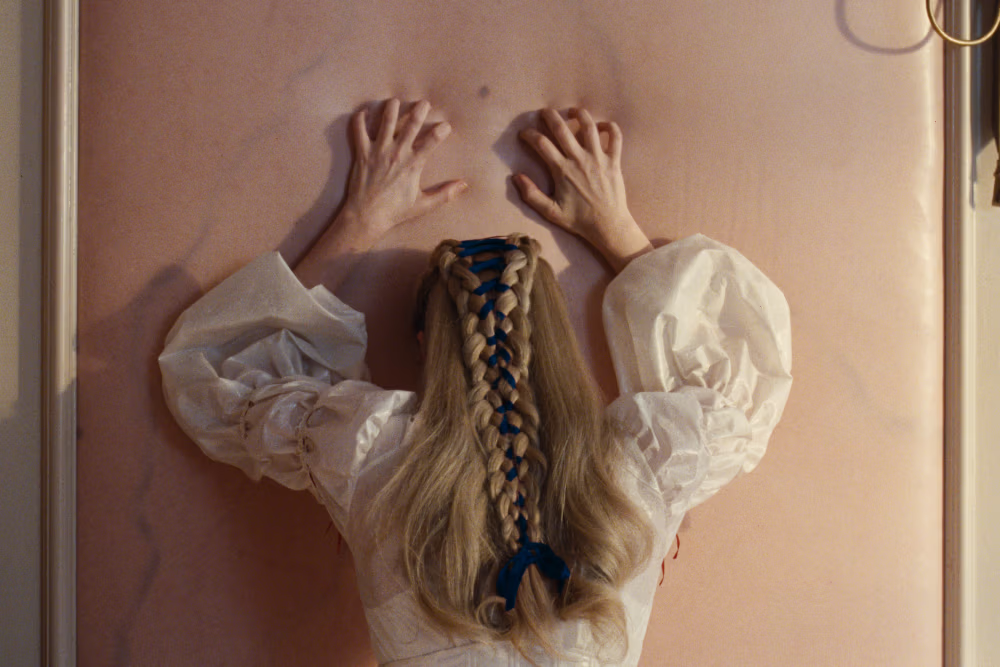
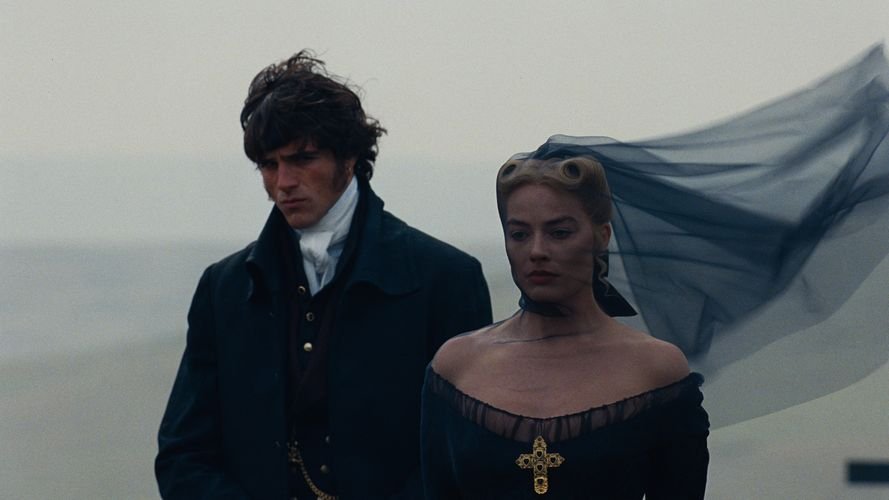
Where the novel hints (but hints strongly) at the romantic and sexual attraction between Cathy and Heathcliff, Fennell’s film thinks, let’s just go for it. Just once. Let’s do a version of the story where Cathy and Heathcliff’s love is about as far away from unconsummated as it’s possible to get. Admittedly, even all this passion gets a little plodding, but there’s undoubtedly chemistry between Robbie and Elordi; the age difference doesn’t seem like a problem, and some of the set pieces used are absolutely painterly. Heathcliff, once the street urchin, has no problem clambering in and out of Thrushcross Grange when he wants; Edgar seems perfectly clueless at first, though when he eventually begins to take back control of his house and his wife, he essentially imprisons Catherine in her room, finally forcing the impasse between her and her true love. Thrushcross Grange here is an enchanted space, lush and strange, a doll’s house world within a doll’s house world, but a gilded cage nonetheless. Catherine’s room, bizarrely, is a facsimile of herself, the walls decorated to resemble her skin, walls which are bled just like she is during her illness. Like The Masque of the Red Death, every room has a colour and a theme, and every room bears closer inspection. It’s not real, and doesn’t want to be. Had an obscure arthouse director come up with this, and had audiences had to seek it out, the film would be lauded around the world.
Of course, no film is perfect and “Wuthering Heights” has a few less successful elements, beyond the repetitive nature of Cathy and Heathcliff’s hook-ups. There are misfires; for example, against an array of earthy Yorkshirewomen grudgingly cleaning up Mr. Earnshaw’s vomit after a libation, we get a strange, strained version of Nelly Dean (Hong Chau) who turns out to be some illegitimate offspring of the landed gentry, dumped at the Heights to alternate between a maid-of-all-work and a haughty lady-in-waiting, sometimes joining in with the housework and sometimes sitting aloft like a moral cipher. There’s no real vigour to the role, and it feels on several occasions that this Nelly is only around to play receptacle to some of the novel’s finest lines. Which, by the way, this film does contain: lots of Cathy and Heathcliff’s most ardent speeches are included and still pack an emotional punch. Some reviewers have been uncomfortable with the few tension-busting moments of humour in the film, but they work: remember, again, that the film is based on a book which has its own, awkward moments of comedy too. Audience discomfort with the most strident reminders of the film’s sexual undertones show a director utterly confident in the version of the story she’s created, who doesn’t much care, and feels like she can joke. It’s refreshing.
There’s a huge weight of expectation around any literary adaptation like this, but Fennell has gone her own way, and whether you can get fully on side with that or not, she deserves praise for it, not snide hostility. She doesn’t owe you social realism, folks, no film ever does, and if you’re feeling a tad “smooth-brained“, go back and read the book.
“Wuthering Heights” (2026) is on general release now.