
The Housemaid paints in very broad strokes. On occasion, its strokes are so broad and even a bit clumsy, that it seems like the paint will tear straight through the canvas. However, if you wait it out, it gets into a much more horror-adjacent, nasty phase which feels like a decent payoff for all the waiting around and second-guessing where it’s all going. If some of the plot twists are a little unlikely come this point, then you may still feel inclined to forgive them. There’s a lot of fun to be had here.
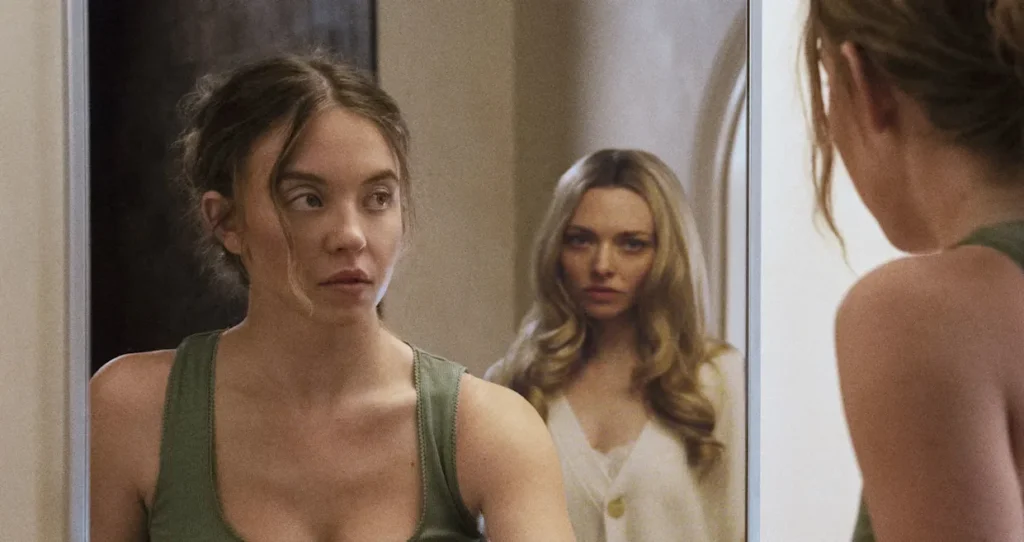
Millie (Sydney Sweeney) arrives for an interview for the post of housemaid at a luxurious home, where she’s not exactly grilled by hausfrau Nina (a brilliantly nervy Amanda Seyfried) about her credentials. It’s clear Nina needs help to keep the house looking pristine, help with meals, and for some occasional babysitting for her seven year old daughter CeCe (Indiana Elle). Husband Andrew (Brandon Sklenar) has one of those incomprehensibly high-paying jobs in IT where it’s never made completely clear what he does – it’s shorthand enough nowadays to just say ‘IT’ and audiences will sagely accept any embarrassment of riches, like this one. This couldn’t be more different than Millie’s background, which is fed to us slowly across the film’s runtime, but at the very beginning of the film we know that she’s sleeping in her car and in desperate need of both work and shelter. As luck would have it, the Winchester residence offers both: it’s a live-in position. Millie never expects to get it, but hey presto, she does. Nina shows her around, explains the role to her a bit more fully, and lets her get settled in. Great.
It’s not very long at all before Nina’s nervy energy breaks out into a flurry of temper tantrums. The first thing that sets her off is a missing PTA speech: she accuses Millie of throwing it away, and trashes the house as a result. Andrew has the manner of a man well-used to soothing his wife’s moods, but it’s enough to rattle Millie – who really can’t afford to lose her place here for reasons beyond simply not wanting to sleep in a car over winter, but she’s soon being asked to give up her Saturdays, do unnecessary errands, any number of things which seem designed just to torment her, or at least make her appear incompetent before anyone who might be watching. It gets harder and harder to decipher Nina’s agenda, as she does genuinely seem to need help to keep the home a happy one, but then acts like Millie is basically intruding there, and has no business speaking to her husband – oh, no. Whatever else is going on with Nina, she has at least correctly identified that Andy getting even a glimpse of Millie’s boobs constitutes an act of war. Depending on your perspective, you could see this as a film which started by storyboarding Sweeney’s bosom and worked back to a broader plot, or perhaps you might see the entire film as an indictment of American labour laws (get a contract!) and by extension, plenty of other laws too, labour-based or otherwise. One of those perspectives may be more motivational than the other, at a wild guess.
Faced with increasingly bizarre behaviour from Nina, Millie finds herself rather drawn to the long-suffering Andy, one of actually two men in the film who seem to hang around the Winchester residence, smouldering (there’s a groundsman called Enzo who is called upon to do little else). It seems that Nina has scored an own goal, if her intent was only to keep her husband and her help separate. However, there’s more to it; Millie slowly gleans that there is a lot more in Nina’s background. Nina is allegedly hiding a slew of secrets, many of which point to a very turbulent, dangerous past which threatens to spill out into the present. Thing is, the same could be said of Millie.
The Housemaid has a host of influences which are more or less straightforward to spot, but given its occasional use of voiceover, and its quite specific chapters (though without literally spelling that out for us, which is nice) it feels most like an alternative riff on Gone Girl – another film which examines feminine roles and secrets, looking at what happens when curated personae and planned futures crash into one another. It also feels, at least in the first half of the film, like some kind of an update on films which appeared in the Nineties – the likes of The Hand That Rocks the Cradle or Single White Female, films about happy homes or settled lives being upended by the arrival of some kind of feminine cuckoo monster. Some of these films haven’t aged all that well; The Housemaid clearly plays with some of the same ideas and holds onto some awareness of the pitfalls, but it takes a swift and different turn in the last act, moving away from the more expected (and more dated) ‘madwoman’ motif, and turning it into something more interesting.
This includes ideas about the great precariousness of lives in modern America, even if played up here, or given unlikely conclusions. Certain people in the film lead very unstable lives; the wealthy forget these people are there at all, or else they luxuriate in the cosy certainty that they call all the shots. At least, right up until they don’t. The film works exceedingly well as a kind of cathartic, even if cartoonish redress of this unfairness, particularly as it impacts upon women and women’s lives. If that means a rather implausible veneer of solidarity at key points, then you can deal with it because by this point the film has shifted gears, ending as something quite fantastical and even grisly. Which, by the way, sees Sweeney’s character growing in pace with the film, and it’s good to see her getting these fun, substantial roles. But I say once again, for anyone who might need to hear it: get a contract.
The Housemaid (2025) is on general release now.