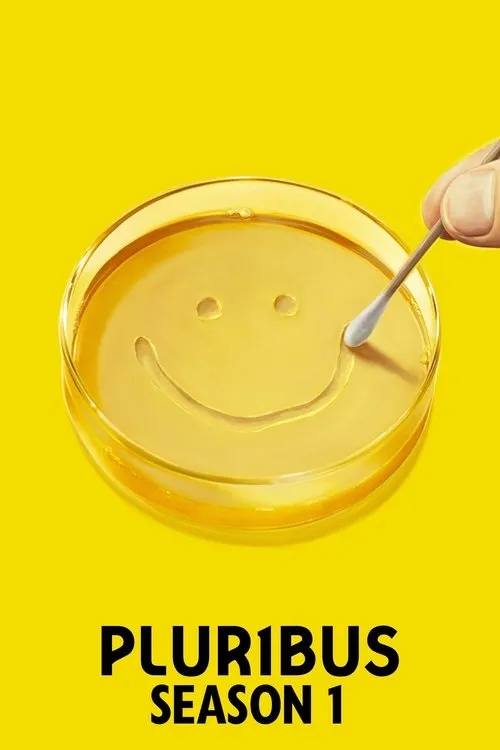

This article contains spoilers for Season One.
There’s no doubt that the new Vince Gilligan series Pluribus – a kind of Invasion of the Body Snatchers for the wellness generation – has been an intriguing, if slow-burn entrant into the post-apocalyptic genre. Post-apocalyptic, that is, from the perspective of Carol Sturka (Rhea Seehorn), one of the perishingly small number of humans (twelve at first) unaffected by a quick alteration to the rest of humanity as they each succumb (again, from Carol’s perspective) to something, hereafter referred to as the Joining.
If you haven’t yet seen the series (and I urge you to watch it, the better to avoid spoilers here), then the premise is as follows. After a small team of scientists decode a radio signal from a distant corner of space which turns out to provide information on how to engineer a segment of RNA, they have a go at making it. An accident spreads the sequence amongst humans, who quickly begin to act like a collective, rather than as individuals. Full exposure occurs soon afterwards when planes are used to disperse the virus, leading to a moment’s switchover which either unites individuals into the Joining – or kills them. It’s kind of an either/or, unless you’re Carol and the other remaining individuals, who are of instant interest to the Joined, who (or perhaps which) is unable at first to understand why some people seem to be immune. Most terrifyingly of all, the Joined behave in a distressingly friendly way. They love Carol; they don’t want to harm her. It’s enough to drive a woman a little mad, and true enough, when Carol loses her temper, millions of the Joined drop dead. Never has humanity taken mass casualty numbers so well. The Joined smile their way through it, of course. These new, happy, former individuals are deeply creepy in their in-built optimism.
It’s been clear throughout Season One that Breaking Bad guru Gilligan intends to be in this universe for the long haul, given the structure of the series and, to an extent, some stockpiling of the potentially more seismic plot points for the last episode of the season. This is the world we live in today and this is how TV gets done, though it’s fair to have high levels of confidence in Gilligan given his track record, even if Pluribus is, at moments, so slow as to feel a little laborious. This article, though, isn’t just about trust or distrust in the process or a straightforward piece of criticism either, but takes a different tack. Namely: I have some questions. Having these questions isn’t itself a criticism of Pluribus, but rather evidence that there is a wealth of material in there so far, which hopefully will yield fruit in seasons to come.
So here’s the first…
If the mice can be infected with the RNA sequence and they initially spread it to humans, why are animals seemingly exempt from any aspect of the Joining?
Okay, I understand that different species can be differently affected by viruses (oh boy, are we aware of that one) but it’s interesting that mice can simply – at least as far as we know – transmit the sequence, without any impact on them. Or is this the case? Elsewhere in the series, Carol’s chaperone Zosia explains that animals are unaffected by the Joining, but it’s via an individual creature that the virus escapes the lab in the first place. Was this just a bite from a lab animal, a coincidence which starts it all? That seems quite strange in itself, as these creatures tend to be very used to being handled, but it could be so. However, it also looked a lot like the mouse manipulated Patient Zero into removing her protective glove by playing dead. Another possibility, then, is that the creature on some level wanted to transmit the sequence, which would suggest a level of knowledge on its part. Knowing that the Joined are not above some clever wordplay or a certain, acceptable amount of obfuscation to protect knowledge which they aren’t keen on sharing, there could be more to this. But if a mere mouse can play dead and plan ahead to an extent, then it would suggest that even without brains as complex as humans, animals may play more of a role here than has been explored so far.
Sticking with animals…
Why don’t the Joined – really – extend their kindness to animals?
The Joined may be a hivemind of care and consideration, at least superficially and at least according to them, but it doesn’t seem like that superior mindset – the one they’re so keen on ensuring every human being shares with them – is able to understand that simply abandoning tame animals is a form of cruelty. I’ll readily admit I felt upset on behalf of a goat during E9, when newly-turned Kusimayu, whom as an individual clearly loved and cared for the animal, simply unties the goat’s enclosure and abandons it after her own Joining becomes possible. Earlier in the series, Zosia explains that the Joined have a completely hands-off approach to the animal kingdom, even sacrificing a few Joined individuals to the frankly barking mad task of letting all of the big predators out of their zoo enclosures. The Joined have also alluded to their own lack of food (see below), so perhaps that justifies not taking up resources to feed to the lions. But many of these animals will likely starve to death, as they lack the abilities to get food for themselves, and many of them may be reliant on their handlers. And that’s just zoo animals. What about all the pets?
We see one dog, unaffected by the virus, still determinedly sticking by its once-owner, and that animal is apparently well tolerated by the Joined. However, that’s just one individual animal. What about the others? Humans have a long, even arguably a co-evolutionary relationship with dogs in particular and there are around sixty-five million dogs in the US alone. Where are they? If we see wolves quickly growing confident enough to approach residential areas in order to dig up bodies (despite wolves being one of the species presumably the least affected by humanity’s sudden turnaround, actually), then it’s bizarre that the streets are not awash with cats and dogs, or that the dogs, in particular, are not distressed by the disappearance of their owners, many of whom will likely have died in the Great Switchover, even if they haven’t successfully Joined.
The Joined have a protocol, if you can call it that, of non-harm. They can’t even cultivate plants for the purposes of farming, and they certainly can’t slaughter animals for food. It’s hard to imagine they’d be averse to recycling animal protein if it happened to present itself, given they have done so with human remains – but in the meantime, how is neglect an acceptable option? How ‘kind’ is that? If this is a clue that the Joined will hide their real motives behind a gloss of benign concern, then it’s a galling one. I hope the fictional goat is okay, by the way.
So the dogs and cats are MIA; the zoo animals are probably going to starve to death; the Joined have concerns about food and supplies which cannot convince them to cultivate even a vegan diet. But perhaps they don’t need too many calories, because something else is currently unclear:
What do the Joined do all day?
So far, we have seen comparatively little of what a day-to-day routine looks like for one of the Joined. As they all commune with the rest of the hivemind all of the time, they only really need to use their verbal facilities when addressing Carol; with the exception of Manousos, who refuses any sustained contact from the Joined until the very last episode of the series, the other unJoined individuals are far more content to simply accept the new way of doing things, and don’t feel the need to debate in the way that Carol does. So these people, or ex-people, aren’t forming any debating societies anytime soon. They aren’t bidden by any political systems either, so they aren’t motivated by making money, elevating certain individuals above others, or castigating any of the groups which formerly comprised society. There’s a general collectivist approach, granted, but that doesn’t really solve the issue of what they’re going to do exactly with their finite resources or how they are using their time on earth.
Here’s what we do know: they are carefully trying to conserve food and energy. They sleep together in shared spaces to keep…warm, I guess, though this is presumably less of a concern in New Mexico than in other sites around the world. They are more than capable of organising an epic flounce when Carol’s behaviour is deemed too risky to tolerate at close quarters, so they can all head off somewhere totally different to do…something or other. And they are always able to get any sorts of resources to Carol almost instantaneously, so there must be enough of a physical presence at hand and enough resources nearby to fulfil Carol’s material needs. When it comes down to it, and as we’ve seen, they can also source things which have absolutely no purpose except to destroy: when Carol asks for a hand grenade, she gets one. When she asks for an atom bomb, that’s fine too. That’s interesting, actually: given that the Joined proposes a system of no harm, they would still provide a recalcitrant individual with the means to blow up either a small number of things, or all the things.
We also know, via a neat narrative gap, that the Joined now have one main priority: constructing a vast antenna, so that they can share the same signal which brought the Joining to earth. To do so will take pretty much all of the planet’s energy resources, but with the zeal of religious converts, they can’t see past this goal. It’s what they owe to the universe. To perform this feat will take probably thousands of people, but too many hands spoil the broth: what are the rest of the people on earth either doing, or about to do? It’s not a job for seven billion.
But still: given the Great Work, and the imminent famine, it seems likely that the Joined would need to limit (or at least to control) population numbers, but equally it seems like they will need a steady stream of new humans to at least work on the antenna, even if we don’t know what else is going on. The logistics of getting the population to a sustainable, useful level is an interesting issue and perhaps an aside too far, but it doesn’t really solve what is going on the rest of the time, once vital repair and maintenance work is done (and we do see this happening early on in the series). Apart from subsisting on cannibal rations, there’s a big question mark hanging over the day-to-day existence of the Joined – which still numbers in the billions – to date.
Can the Joined adapt their behaviour? Is that possible? How, exactly, have these rather pig-headed moral values been encoded in the first place? Could they change how they do some things in order to benefit the whole? I mean, I know humans are rather bad at this, but we have millennia of being idiots to set the precedent. In the meantime, the notion of all of these Joined people simply kicking around somewhere, waiting for Carol to come around to their way of doing things is, in its way, just as eerie as the more major events which take place during the season. There is also such a lot of space here for Carol to interrogate the Joined that this can’t help but become a key plot point in future series.
Because there’s one more adjacent issue here…
What’s it all for?
As above, human beings are idiots – but there’s a kind of pattern, or a series of patterns to how we use our time, developed over the centuries, which suggests that we at least appreciate that this time is limited; we feel certain things, we understand certain things (or feel that we do), and certain ideas are vitally important to us. Many of these priorities form into recognisable shapes. For example, some people decide to prioritise having families of their own. Other people – though not mutually exclusively – want to leave something to posterity. They, or we, want to build, invent, design. People perceive problems, then they want to channel their energies into solving those problems. On occasion – actually, far more often than occasionally – people’s entrenched prejudices mean that they want to kick lumps out of certain groups of people, and they will devote days, years or even generations to doing just that. Without getting too much further into the wretched but diverse state of humanity, what this shows is that humans feel, overall, that our lives should be spent doing something. Better still if they’re competing with those bastards over there as they do it.
So what motivates the Joined? What is their time for? If it’s all only about perpetuating a kind of hivemind across the galaxies, then that feels more like a step along the way to something else, not the final destination – but perhaps that’s my errant humanity talking. A whole universe full of lifeforms who want nothing but to make other lifeforms feel the way they do; that’s the main acknowledged goal for the Joined. Okay, but so what? Once this sense of shared belonging is everywhere, what happens? What do they want to build? Anything?
So far, the concept of a collective consciousness which is about nothing beyond itself feels just as terrifying as other, soulless dystopian dramas, and operates along the same lines – revulsion, rejection and a desire to protect individuality. Just because the Joined smile and wave rather than pointing and screaming, doesn’t seem to matter ultimately: their idealised state still feels like a nightmare. But there are already cracks in their armour, offering intriguing scope for exploration.

Thanks to a couple of things – Carol’s truth serum, and Manousos’s so-far rudimentary understanding of the relationship between the Joined and radio frequency – we already know that there remains the possibility for turning the Joined back into individuals. We also know that this possibility is a frightening prospect for the Joined, who will do what they can to protect themselves from this (and is it just me, or did Zosia’s heart attack feel like strangely lucky timing, given Carol’s line of questioning at that moment?) It’s really only because of Carol’s all too human inability to really appreciate that ‘Zosia’ does not exist that stops her in her tracks, and makes her actively resist Manousos on behalf of the Joined when he gets oh-so close to cracking the electromagnetic code, which seems to keep the Joined all operating on one frequency (no mean feat, by the way, for a man who has only just started reading in English). But we now know there are ways to get at the individuals who once were, and that the kindly Joined will do whatever they self-permit to stop the old order from resuming; on some level, they want to exist and they want to survive. That’s interesting, and so far underexplored.
Unless the Joined can come up with a reason for existing which goes beyond ‘feeling nice and happy’, then they could be in real trouble. As already discussed, ever underestimate the dogged insistence of humankind once it gets hold of an aim; the Joined may well not be a match for it, and it seems highly likely that Gilligan will play around with these frankly rather philosophical possibilities once we head into Season 2 of Pluribus – which is currently rumoured to appear in 2027. Oh, and there’s the small matter of Carol’s renewed anger over the Joined and how they have, after all, found a way to backwards-engineer a connection to the hivemind without her consent, badly misjudging Carol’s mood and forgetting just what drives human emotional connection, and how hard it is to set all of that aside. Mess with someone’s stem cells at your peril, and – it seems likely, at least – be ready to reap the whirlwind which will follow.