
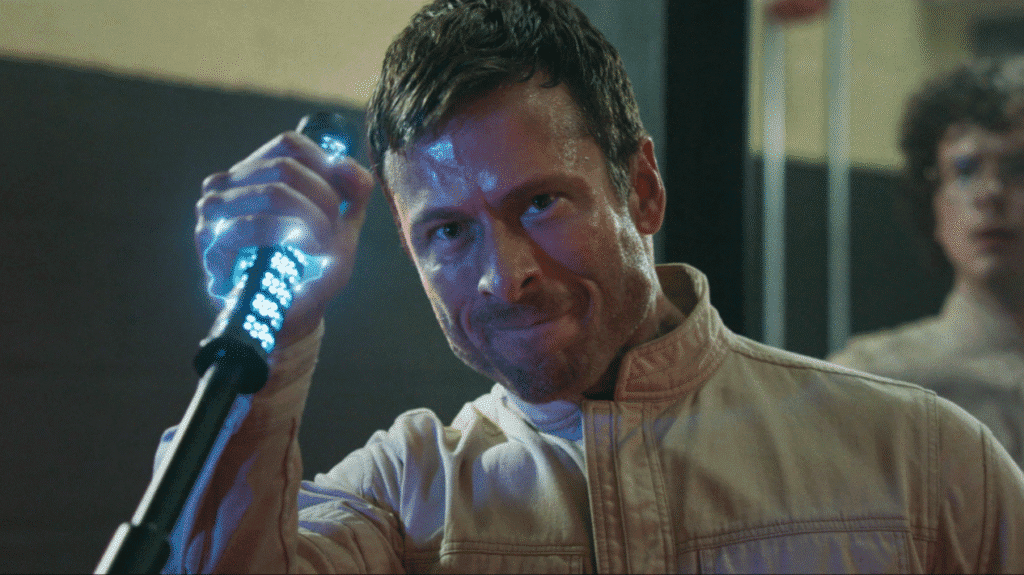
Is it me, or do even the most improbable dystopian situations feel a whisker away these days? Perhaps The Running Man (2025) feels oh-so close at hand because the novel on which it’s based, with its novel-contemporary analogue tech and big budget gameshow format blends so nicely with our world, billionaire media conglomerates with their snazzy, surveilling screens included. Whatever it is, The Running Man – a new adaptation, rather than strictly a remake – feels very discomfiting in many places. Since Stephen King wrote the book in ’82 (and faster still since the 1987 movie version was made), the world of reality TV has kicked into top gear; you feel uneasily sure that if Netflix could only perfect the world’s most watertight waiver, they’d think about making a show like this. Oh, they would. They’d almost certainly make Speed the Wheel, one of the other shows we glimpse during The Running Man, except for the fact that we’ve already had The Biggest Loser and it would be a bit passé now. One of director Edgar Wright’s biggest successes here is understanding you don’t need to embellish 2025 all that much to create an engaging backdrop for your own big event. The film’s frequent refrain of, “Stop filming me!” could be spoken almost anywhere in our brave new world.
It does take a little while to feel like an Edgar Wright film, though: perhaps he was conscious of wanting or needing to do a lot with this project, given how long he’d wanted to make it. In places, the film can feel uncomfortably stretched between sci-fi, action and moments of slightly tonally odd humour, even though humour has often been an integral ingredient in his films. Or, and it would be ironic if so, perhaps he was constrained by financiers who wanted a say in some of the film’s inclusions and changes, if there are more influences at play here than Wright himself.
But anyway: Ben Richards (Glen Powell) lives in a world of stacked decks. Whilst he’s been fortunate enough to father a daughter with his wife despite the radioactive dust allowed to settle, consequence free, on the working poor, he’s been unfortunate in terms of his career: he’s been essentially blacklisted from gainful employment due to once ‘damaging a company harness’ (actually saving a colleague). His daughter is sickly and needs medical care; little wonder, then, that Ben is a very angry man – in fact, he’s pissed off enough for us to believe he’d take the desperate step of auditioning to take part in the new season of The Running Man, a show which relies on a steady stream of shuffling desperados to entertain the masses. By the by, that part of his screen test where he responds to trigger words in his own inimitable way? One of an already (to this reviewer’s mind) strong script’s most successful moments.
The show itself is very different here to the gameshow version dreamed up for Arnold Schwarzenegger in the Eighties, in a film which has now cemented itself as ‘one of those classics’ from the decade (although praise wasn’t immediate, or unequivocal for that one). Here, as in the book, it’s survival out in the community which is key. Run, hide, avoid, prove you’re still alive by mailing video diaries to the network, and keep going for the duration: thirty days. This is a tough call, given that every flat surface in this version of the modern world has a screen displaying Richards’ face, phoning him in carries a cash incentive, and there’s a crack team of trained hunters on his tail.
The Running Man has an illustrious history: it’s long been a huge success for the Network (hmm, that’s a prominent ‘N’ they use – where have we seen that before?). In this universe, the Network has a stake in everything, operating as a de facto system of government, policing and surveillance. Key to the show’s success is the Network’s shadowy executive, Dan Killian (Josh Brolin) – a smooth, omniscient character, 100% confident of his format and his reach. Brolin is good in this role; it always feels like a plus when he turns up in anything, so having something decently engaging for him to do here is a boon. He can and does offer Richards everything he needs; there are cash bonuses peppered throughout the game – more than enough to set the Richards family up for life – if Richards will only play the crowd-pleasing role Killian expects.
The Running Man initially comes out fighting in a way which belies its two hours plus runtime, offering up a really punchy opening act, establishing its own rigged system with plentiful, neat plot additions to suggest it. The balance between the dull, grey-washed drudgery of the downtrodden and the high-colour, high-end schmaltz of the Network itself works well, with enough characterisation along the way, and the first throes of the chase are compelling. Although in some paces the cat and mouse pursuit can feel a little repetitive, the film’s biggest slabs of action reliably come along to rev things up (if in doubt, add an explosion. It worked in the Eighties and it works now.) But perhaps The Running Man‘s best quality is its zeal for presenting TV as the final frontier of corruption, making this point by presenting only-just sharper versions of AI and surveillance technology, employed by the Network to ‘control the narrative’, another very real concept which has filtered down to us.
The film cycles through pursuit, paranoia and violence in turns, leading into a finale which feels like a good payoff even if – and this is a key criticism – it can’t quite trust itself to just tell the original tale, without some needless fourth-wall hijinks and a surprise dip in faith. It’s also odd that a film of this length still feels a little rushed at the end, with the slightly clunky addition of a new character at a point where it can’t quite bed in. But The Running Man is an exuberant and arresting spin on the source material nonetheless, made with enough lavish love and care to pull through in the end: it’s disappointing that it’s only recouped a fraction of its budget so far, but give it some time. Thirty days would be nice and neat, but realistically it may take longer than that, and some viewers will find that they halt for good at some of the film’s more challenging tonal and timing shifts. For this reviewer, though, there’s a lot to enjoy and incidentally, it’s also great to see the steps to Wembley Stadium being given new life as a setting here. This is a solid film which deserves a lot of praise.
The Running Man (2025) is on general release now.