
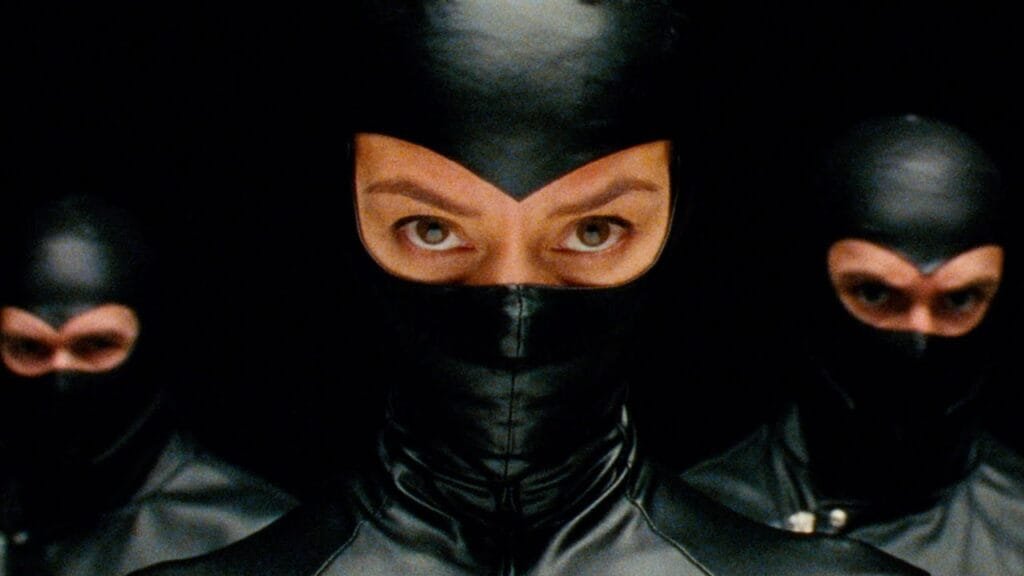
Ah, here we go then. An older man who seems to be living and bill-dodging at a hotel on the French Riviera (Fabio Testi) becomes fixated by a young woman on the beach; the diamond jewellery in her nipple (!) prompts him on a fractured and somewhat looping trip down Memory Lane, as he recollects his heyday as a secret agent. An array of improbable James Bond-style gadgets and suave villains shift Reflection in a Dead Diamond somewhat away from giallo homage, the usual visual style favoured by directors Hélène Cattet and Bruno Forzani, but arguably not all the way elsewhere; there’s still some Argento and still some Bava in here, alongside the newer spy thriller and eurocrime references. Anyway, what at first seems to be the memory of the investigation of a crime kingpin gradually turns into an array of double dealings and investigations united by the hunt for a leather-clad murderess known as Serpentik. That is, this is all in the past: it takes a while to realise it, but the other suave guy we encounter in the early part of the film is the same man we meet at the hotel in his older years – one John Diman.
I think that’s what’s going on, but I’m already reaching here: the hardest part of writing any review of these directors’ work is identifying the smattering of plot which they usually decide to provide, sifting it from the visuals and the mood pieces, which are and have always been their priority. There’s perhaps more dialogue in this film than in previous titles, echoing its cinematic influences perhaps, but also to an extent misrepresenting the film as having more meaningful narrative elements than it does. You naturally spend longer pondering what is being said if it’s in there, before you’re made to acknowledge that there’s still little meaningful to guide you. The layering of timelines in this film makes it near impossible to follow, too, which altogether feels more challenging than having no discernible plot elements at all. You feel that, if the filmmakers have put it in, then it must mean something, so you endeavour to follow it – but you wind up following it nowhere. Reflection in a Dead Diamond is another sumptuous but tedious melee of femmes fatales, funky macros and might-be symbolism. Surely not yet another metafilm made for critics to decode, rather than for audiences? Another issue: is it meant to be comedic? A table football massacre? Who’s laughing at who here, and should they be?
Look, I get it: Cattet and Forzani have spent years developing an unusually painterly cinematic style which offers tribute to their formative cinema favourites in an unorthodox way, endeavouring to blend retro genres with a very singular arthouse vibe. And as usual, Reflection in a Dead Diamond is a visual wonder, every shot seemingly composed by an artist (and here, given the film’s links to comic books, in a way which could – and does – fit specifically into comic book panels). The film has stacks of the requisite otherworldly charm, with an array of close-ups, landscapes and shots which spin, solarise, shimmer and blur. There are brilliant ideas everywhere, things like explorations of ideas about crime, duplicity and artifice through silhouettes, blasting wounds into one another which erupt into cascades of diamonds. It’s pretty. The film’s tableaux are, in their own way, totally absorbing. The multilingual approach, the ways the film largely resists being grounded in a specific time and place, the occasional (and surprising) breaking of the fourth wall and the gradual segue into film-as-comic all reveal a creative and ambitious zeal for the art of cinematography. It’s possible to acknowledge all of that, and still feel disappointed.
Despite their passionate advocacy of an impressive line-up of genre titles, Cattet and Forzani persist in emptying their favourite titles of any meaning, paying a compliment by disposing of even the fractured coherence of, say, a Schivazappa title, which feels like no compliment at all. And it has happened over and over; that continuation, in a world where people struggle to get films made, feels as engaging as anything actually contained in the films. What is it about these wholly visual paeans that keep them coming? Perhaps we can forgive the presence of an idiot at the party if they’re really, really, really good looking? The directors are clearly having fun, true, and having more fun here than they’ve had in their previous titles, arguably – but by making it so difficult for their audiences to feel the same unless they, too, give up on understanding any of it, ultimately it doesn’t feel very clever or respectful at all.
Reflection in a Dead Diamond receives a limited theatrical release on 21st November 2025.