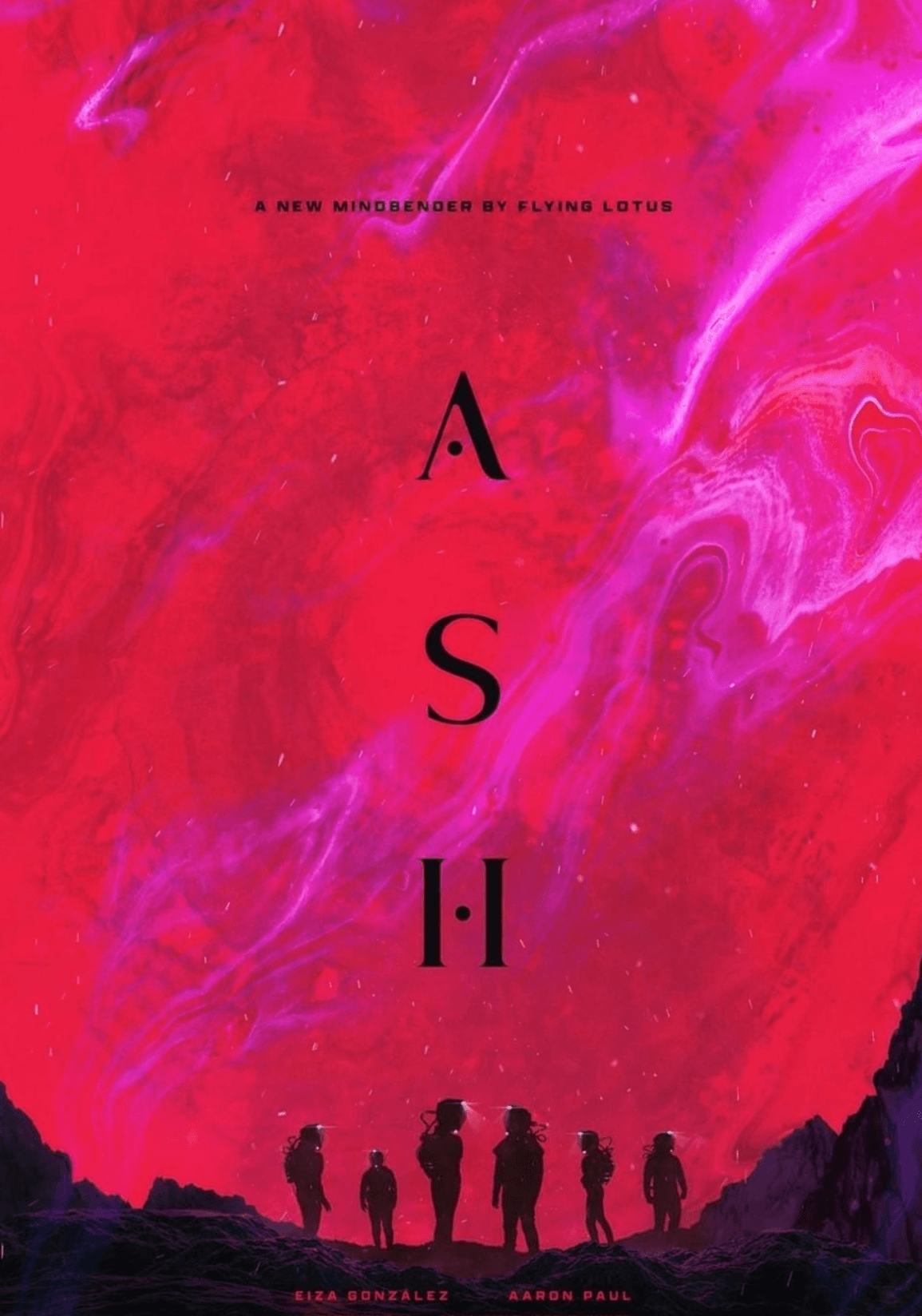

Ash (2025) is, for the most part, as much about thoughts, impressions and experiences as it is a conventional piece of narrative film. It comes in like a space-age fever dream, all body horror and blaring noise, before pausing on the lone, prone figure of Riya (Eiza González), injured and amnesic on the floor of a remote space station. Something catastrophic has happened: the computer keeps on euphemistically intoning that “abnormal activity” has been detected, though it’s some time before Riya sees the worst of whatever went down during her unexplained unconsciousness. There are bodies – the bodies of the rest of the crew, seemingly dispatched in a range of graphically cruel ways.
Directed by Flying Lotus – who also directed one of the chapters in the horribly laboured portmanteau film V/H/S/99 – Ash is, thankfully and appropriately, worlds apart from the earlier offering. The first impression is that the director saw and enjoyed Blade Runner 2049 in all its sumptuously colourful, brooding intensity and thought: yeah, how do we do that, only more? The result is, even if we’re only talking aesthetics, a triumph. We follow Riya as she explores first the station, then the barren, volcanic vista outside. Sensory overload is starting to kick in even before the opening title appears, so it’s a brief relief to get some flashback scenes, meeting the still living crew back before whatever horrors which occurred in this place.
The film feels deliberately written to be intense and lonely; González, thriving in a film which never gets too heavy on the dialogue, is more than up to the role, though things change very suddenly when another crew member appears. Working in orbit until now, Brian (Aaron Paul) is responding to a distress call, so he arrives expecting the worst, and duly receives it. Whilst his presence helps to some extent to fill in the blanks – it turns out it was Riya, for example, who actually made the distress call – it also prompts Riya to reveal that she can’t really remember anything. Not just in terms of the deaths of the crew; she can’t remember where she is, or who she is. Brian tries to reassure her that this kind of soul-searching has long been a part of her personality, but it’s small comfort to a young woman intermittently plagued with half-glimpsed memories and a building sense of trauma. She does, though, keep coming back to one idea: Clarke (Kate Elliot), whose body seems to be missing, may just be the one behind all of this.
Maybe, maybe not; nothing is real out here, except one fact which Brian is keen to press home: the station is irreparably damaged, and they need to leave if they’re going to survive. Taking some cues from the hostile planets of other sci-fi universes – clearly, terraforming is a mug’s game and it shouldn’t be attempted – they only have a brief window in which they can take off to safety. The mystery of the station may need to remain unsolved; Riya finds this idea impossible. She has to know what happened if she’s to move on, or even if she’s to find some peace of mind within herself.
Ash strives to balance its more spiritual concerns, if we can call them that, with a broader and more familiar plotline of exploration and settlement against the odds. This does mean that in places, the balance feels somewhat awry – not quite an existential tale, not quite a conventional tale – but Ash definitely rallies itself, setting aside its comparatively minor thematic and pacing issues to drive towards an assured and grisly, if increasingly familiar-feeling plot shift. As well as a successful and largely satisfying bigger picture, it also does well on the minor details. It’s hard not to mention Blade Runner again here, though the 1982 one this time: such as, the use of spoken Japanese by machines used by an English-speaking team, which is a puzzler, but also an engaging contrast with the tech which makes use of it, tech which is a mix of barbarous and quaintly functional, even oddly archaic. It’s even funny in places. Prometheus (2012) couldn’t do funny (at least on purpose).
There are arguably lots of sci-fi influences on Ash: moments or ideas from games like Starfield, films like Dead Space and Moon and even TV episodes such as The Very Pulse of the Machine can all be charted in this film, which, if nothing else, shows that it has a lot of independently excellent and diverse influences altogether, or that it is channelling similar, complex ideas. In places, perhaps Ash casts its net a little wide, but it has so many superb qualities that it hardly matters, come the end. It’s so startlingly beautiful, for one thing, that you can forget any minor concerns over its more obtuse elements – and then, its finesse and vision more than carry it to its ending. The more I think about it, the more it feels like this could be a cult classic in waiting, and a film which will eventually garner an enthusiastic fan following.
Ash (2025) is available to stream on Shudder.