
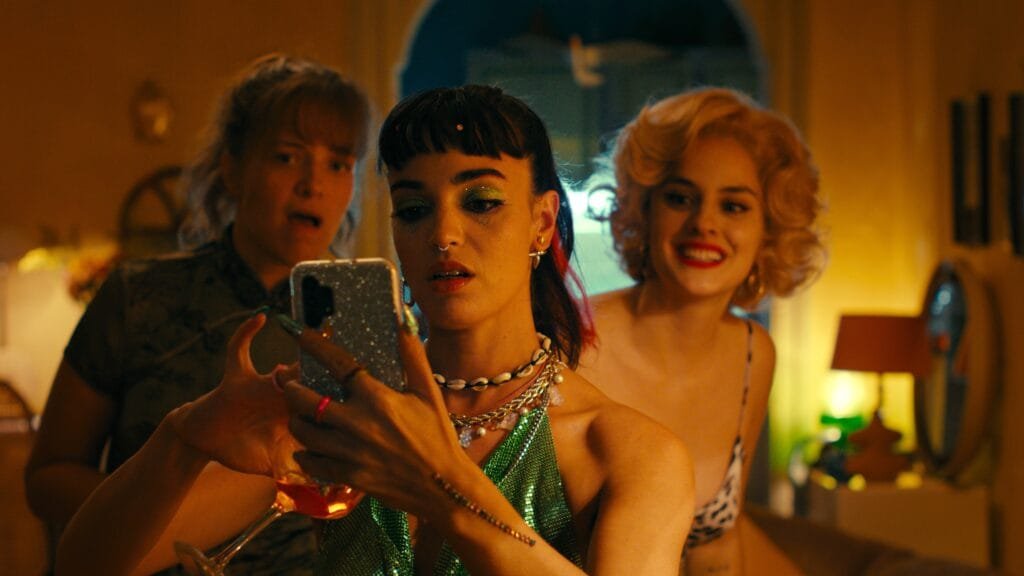
The Balconettes (2024) is an odd customer. It perhaps starts with the title, a slightly clunky translation of the French title, Les femmes au balcon – choosing a word which may indeed mean ‘women on the balcony’ but is more likely to conjure the word ‘bra’ for most Anglophone audiences. It’s not the last time that the film seems to foreground undies, when it really ought to be focusing on its more serious points more seriously – but we’ll get to that.
The film is set in Marseilles; there’s a heatwave, and we start with the camera roving over some apartment frontages, looking at the residents trying to keep cool. It lingers on a woman called Denise, who was flat out on her own balcony until her loutish husband decided to hurl water over her to get her up on her feet: he’s ‘hungry’, and apparently unable to fend for himself. Denise sees red at this intrusion – clearly this is the final straw – and decides to deck her hubby with a heavy iron dustpan, making sure to finish the job. This, by the by, is only briefly relevant: Denise may have been au balcon, but she’s not a balconette.
Instead we have Nicole (Sanda Codreanu), a struggling writer; Ruby (Souheila Yacoub), a free spirit/camgirl, and Élise (also director and co-writer Noémie Merlant), an actress, who spends a share of the film dressed as Marilyn Monroe, after hurtling from Paris to Marseille to get away from her overbearing husband. The three young women enjoy being reunited, drinking and dining on the balcony of their apartment. While they’re out there, they start communicating with the Hot Guy From Opposite who has, unbeknownst to him, already started to become the inspiration for Nicole’s new novel.
Despite the brief outbreak of violence at the start of the film – and Denise (Nadège Beausson-Diagne) doesn’t really spend much time with the other women, save for popping in and jokily confessing her crime to an equally jovial Nicole – The Balconettes endures a painfully quirky start, all told. The giggly reunion, the unspoken crushes, the mild voyeurism and the colourful underwear airing everywhere (this is a very knicker-rich environment) all suggest a romcom kind of affair, and when the girls are finally invited over to Hot Guy’s apartment opposite, the giggling and the drinking continue. However, the better they get to know the Hot Guy From Opposite, who turns out to be a photographer, the more things start to become complicated. He asks to photograph Ruby; she agrees; she stays behind – and the film takes a much darker turn.
The Balconettes could easily withstand this about-face, and to an extent it does, but things dwindle here, as each woman separates and goes her own way for a while. Issues occur as the film elects to park the mystery of that fateful night, leaving us with a negative space in the film which takes up time and pace before handing down even the most basic answers. Even if you can guess what’s going on, it still feels like it runs out of steam. It elects to provide more backstory for some of the characters, which is why we get this shift in pace, but in the main this means presenting all of the men – with the exception, also somewhat quirkily, of a kindly gynaecologist – as comic obstacles at best, but more likely stroppy, overbearing and terminally horny monsters. This isn’t without precedent, in film or in discourse more broadly, but given the ways in which the film drifts further and further into big, uncomfortable topics, the film’s colourful, idiosyncratic approach sits uncomfortably at times. There’s feminine bonding and clashing fashions; then there’s gore, there’s splatter, there’s some surprisingly explicit content, and then it goes from realist moments to outright supernatural fantasy; the film is both diffuse in places, and yet very crowded more generally.
For all that – and for all of the genre-straddling goings-on, which will almost certainly make it harder for this film to find a large and receptive audience – there’s enough bizarre energy and ambition here to make The Balconettes oddly, dementedly appealing in enough ways for me to say: it’s somehow impossible to really dislike it. It’s eccentric, overdrawn, and at its worst it makes light of male-on-female violence, which is a tough sell. But its acid colour aesthetics, its great locations and sets, its moments of real warmth between friends and its attempts to combine horror, comedy and Millennial liberation speak at least to big aspirations on the part of Merlant, who’s guilty of throwing a lot at this one, but not of playing it safe, at least. Are the fart jokes a bridge too far? Maybe. But whilst The Balconettes is uneven, it’s charming, and weaving that kind of charm together counts for a good deal.