By Keri O’Shea
I’d been wondering what had happened to director Sean Byrne since his brilliant debut feature The Loved Ones assured audiences that you could still weave an effective, horrific and ultimately heartwarming story out of elements which – on the surface – seem tried-and-tested. Incredibly, it’s been seven years since that film was made, so when I heard that Byrne had penned and directed a heavy-metal-infused occult horror, I was certainly interested. The resulting film – The Devil’s Candy – is a very different animal to its predecessor in many respects, although there is some overlap too, in so far as the newer film also shows a family unit pulled apart by a malign outsider influence.
The Hellman family (a very metal surname, excepting the fact that most of us probably associate it with mayonnaise) consists of artist father Jesse, mother Astrid and twelve year old Zooey, who has inherited her dad’s love of heavy music. Trying to make a living as a painter is hard going – so when the family finds a larger home in their native Texas which comes at an absolute steal, they decide to go for it; it has more space for dad to paint, a large roaming-size bedroom for their pre-teen daughter, oh, and a history of death. We as audience members already know of a tragedy which happened at the house; a middle-aged man, Ray, who had a history of psychiatric care, was tormented by supernatural voices which seem to emanate from the very walls of the house, and apparently tried to find solace via loudly playing chords on an electric guitar. Naturally, this form of self-help didn’t go down well with his elderly parents – whose attempts to remonstrate with him ended badly. Still, the real estate guy is honest about this episode, and the new family decide that it doesn’t matter, in the grand scheme of things. A bargain is a bargain.
So far, so good and the family move in; only thing is, it’s not long before the strange voices and visions which plagued the last incumbent start to bother Jesse, too. Perhaps a lifetime’s experience of a musical genre associated with the devil has given him some coping strategies – he doesn’t seem to go off the rails to the same extent as Ray, but the influence of the house soon begins to creep in to his art, until the benign butterfly-themed canvas he had been commissioned to finish starts to look like something by Joe Coleman. Oh, and more worryingly, there seem to be links between what he’s painting, and What Ray Does Next: the previous inhabitant isn’t in jail, after all, and is continuing to act as the voices command him, soon linking the tormented children emerging on the canvas with real-life acts of violence. But whose voice is behind these acts?
I think the first thing which this film does well is also one of its most understated components, and it’s something both Ben and I commented on after the screening – what with him about to move house, and me having bought a house and moved this year. The Devil’s Candy is a pointed reminder of just how vulnerable we can actually be when moving into a house which is ostensibly now ‘ours’. The film shows that Ray still considers the Hellman house to be his home; he turns up, demands entry, and interacts with the new family. More than that, he still has a key and lets himself in – turning up in Zooey’s bedroom one night for a scene which is decidedly creepy. When it comes to it, how many of us change the locks when we move house? I’ve moved eleven times and I’ve never done it, even though now I come to think of it, I did actually once wake up to find one of my crook landlord’s workmen in my bedroom (oh hey, thanks for unearthing that one, Mr. Byrne). It’s a simple enough plot device in the film, but it works very well and actually, a lot of the ensuing horror hinges upon this one element.
Byrne and his actors have also given us a family unit which we can care about, too: without sentimentality, or masses of explanatory dialogue, we can believe in and like this unorthodox bunch of characters. I spent a large part of the time thinking Jesse was being acted by Matthew McConaughey (there IS a likeness there with Rust Cohle) so my apologies to Ethan Embry, who has had a long and varied career to date, but hasn’t done a great deal in the way of horror movies before this. He carries the film skilfully, balancing the tormented artist shtick well against his performance as a dedicated, loving father. Mother Shiri Appleby is equally put through her paces by some of the film’s more gruelling moments, whilst Zooey (Kiara Glasco, who has already notched up a performance in a Cronenberg film) is believably sharp and vulnerable by turns. Then there’s Ray himself (Pruitt Taylor Vince), a bold piece of casting because, to external appearances, he looks a little vulnerable, too. This film would have been a very different experience had Byrne cast some angular, wild-eyed individual to play a straightforward villain, and a less confident director probably would have done this. As it stands, Taylor Vince can be ambiguous, an important capacity in slowly building the sense of supernatural threat – which itself throws a possible curveball at the end…
I only have one minor quibble with what is otherwise an interesting and well-made film – and that refers to something which several filmmakers seem to have found impossible to resist when delving into the world of heavy metal as a source of storyline. The Devil’s Candy has a couple of moments, but one in particular where it can’t resist playing an element for laughs; it’s a pretty hefty tonal shift at a key moment, and one which doesn’t rest too comfortably with what’s come before it. Interestingly, the moment itself is emblazoned on the poster art for the film; I’d have tried to avoid the whole rawk cliche, personally, as it’s not needed to take the film anywhere: The Devil’s Candy is a very different type of film to splatter parodies such as Deathgasm – and so it should be allowed to be.
Overall, however, this is a well-crafted horror film, another example of Sean Byrne taking some familiar components of the genre and recombining them into a decent, pacy and often innovative story. Whilst it doesn’t have the pure visceral glee of The Loved Ones, it’s proof positive that Byrne is willing to explore the genre in a series of different ways, and I sincerely hope that he doesn’t take another seven years to show us what else he can do.

 This brings me to What We Become (2015), a film which is oddly enough not the first Danish zombie film I’ve ever seen, giving the lie to the trivia section of its IMDb page, but oddly enough, it labours under a lot of the same issues that I talked about five years ago when I reviewed its predecessor,
 The film begins with a young Romanian woman, Elena (Cosmina Stratan) being driven to her new place of work, where she’ll be acting as housekeeper and assisting Louise (Ellen Dorrit Petersen), who is recuperating after an illness. Louise and her husband Kasper (Peter Christoffersen) live an isolated and largely self-sufficient life on their small Swedish estate: there’s no running water, no electricity (the New-Agey Louise seems to actively fear it) but the married couple seem fine with their no-mod-cons existence, and the house’s environs are indisputably serene and beautiful.
 Where the film parts ways with the aforementioned series, however, is in its real-life historical basis. The director of The Last King, Nils Gaup, made a Viking-themed film titled Pathfinder in the 1980s (a film I love, though I take issue with some of the characterisation). Well, his most recent feature is far more firmly anchored in realism, though coming from that intersection between myth and history which usually arises with a good yarn. Coming post-Viking Age, the film is set in Norway in the year 1204. Although Norway has been Christianised by this point, as elsewhere in Europe the whole ‘love thy neighbour as thyself’ gambit has been ignored in favour of factionalism and brutal attempts to seize power; Norway is divided into small kingdoms, with the East Norwegian/Danish alliance, the Baglers, vying for control over the independent West. Fearing imminent invasion, the king sends some of his loyal Birkebeiners to escort his illegitimate baby son Håkon Håkonson – and the baby’s mother – to safety, ahead of the invading army. Illegitimate or not, the boy is in line to the throne, and will be killed if he’s discovered and identified. However, what seems initially to be a successful mission is thwarted by traitors in the king’s camp, who see the two friends – Torstein and Skjervald (Lilyhammer’s Jakob Oftebro) – taking the child to safety. Skjervald is followed and information as to little Håkonson’s whereabouts is brutally extracted from his young family. There’s our coming vengeance angle, then – but can the Birkebeiners prevent an overthrow of power which seems to come as much from within the country as without? Life at court is just as fraught with risk and duplicitious goings-on…
 When they do, what we see is a fairly robust and stylish set of visuals – based on first impressions, presumably there’s at least some cash and some clue behind this project, as shown by the prettily-shot woman bathing in (and, for want of a better expression, gargling with) blood. Furthermore, there’s an early surprise when we seem to start with urban horror, as police discover a gruesome scene within the confines of an otherwise normal apartment block in Seattle. Still, this turns out to be a parallel plot line: as a detective tries to get to the bottom of what happened in the apartment, an expected group of twentysomethings are indeed getting ready to head into the boonies for a 4th July party. A few unnecessary lines of dialogue tell us that there is limited cellphone signal at the cabin they’re staying in, and as ever I’m unclear on whether this group of old schoolfriends are meant to be hateable or relatable, but feeling called upon to ponder this now seems as ubiquitous a part of cabin-based horror, for me, as the bikinis and the weak bottled beers.
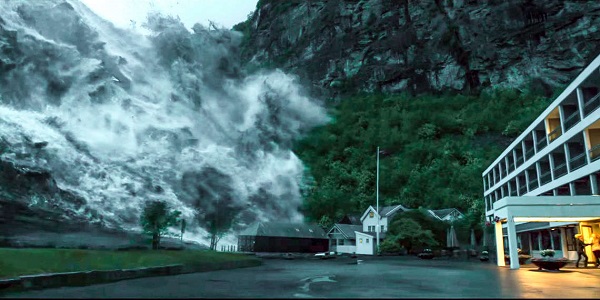 A lot of the films we cover on the site relate to the great ‘what if?’, the playing out of fantastical scenarios, some more realistic, many supernatural and many fairly impossible if not utterly so – but a genre we rarely get asked to cover is the disaster movie. It’s strange that so very few good disaster movies cross our paths, really, because if we’re fascinated with ‘what ifs’, then surely there’s plenty of horror and drama to derive from the ‘not ifs, whens’. This is the precise set-up for The Wave (aka Bølgen), a Norwegian-language disaster film which starts with some real-life footage of a twentieth-century rockslide which obliterated a Norwegian village called Geiranger. We’re told that this kind of rockslide will inevitably happen again in future, and that a site called the Åkernes Crevice is at especial risk of further widening, which when – not if – it does, will send a massive amount of debris into the fjord beneath, creating a tsunami likely to wipe out all of the picturesque homes on the fjord’s shores. It’s something you can’t help but bear in mind as you watch the film unfold, and whilst The Wave carries with it some tried-and-tested disaster movie plot devices, it’s already one step up in terms of engagement.
 The Bloodstained Butterfly starts off with some understanding of this: a beautiful French student is found, dead, in the woods – wearing the bloodstained butterfly of the title around her neck, we assume (and the follow-up scene is of course of some amorous lovers, thus splicing death with sex, as is traditional.) Clearly there’s a maniac at large, or we wouldn’t be watching this story – but the heavy rain at the time of the killing has watched away the forensic evidence, and the killer managed to evade the dragnet which attempts to close in as soon as the alarm is raised. All that’s known about him, at this point, is that he’s clad in a beige raincoat. The hunt is on. Or, rather, we then see a slow succession of lab processes and meticulous ‘going over the evidence’ in order to close in on the possible culprit. When a witness comes forward to say she knows who the killer is, the case takes a turn: it seems, then, that the girl’s lover, a TV presenter, was the man responsible. Others corroborate, and soon the erstwhile TV star, Allesandro Marchi, is hauled into court on seemingly damning evidence of his involvement. Things are, however, rarely this straightforward. As the case is debated – at length – other factors are revealed, and it seems that Marchi might not be the maniac after all. A philanderer, yes, but perhaps not the murderer…

 The Arrow release is, as I have suggested, the definitive deal, containing all of the films in their entirety: the prints look good, though the third film retains a rather grainy veneer, and the audio is solid throughout. This all brings me, however, to a rare smattering of criticisms. Firstly – the main cover art for this is rather lacklustre. No personal disrespect intended towards the artist, but this isn’t the usual calibre for an Arrow release, neither clearly in keeping with the manga style to my eye (which I dislike actually, but would tie in with the films’ origins) nor showing the draftsmanship I’ve come to expect. It surely takes some doing to make Meiko Kaji look ugly. Sorry. However, I haven’t seen the fold-outs or other materials, so these may be another story altogether.
 And here’s the first thing I’d forgotten: the film-within-a-film framework which kicks things off, where a TV show called One Dollar Movie introduces the film alongside a very silly lottery for its viewers. Cue a FULL 80S beach scene, with lots of aimless bikini dancing to a ghetto blaster – wait, that’s the wrong film, so that’s exchanged, and then we’re into the intended film, which starts in a FULL 80S laboratory scene. You know an 80s laboratory –